The Illusion of the Perfect Forecast
If the universe follows rules, why can a tiny detail still send the future somewhere no forecast can follow? A piece about chaos, prediction, and the strange humility hidden inside deterministic systems.
14 October 2026
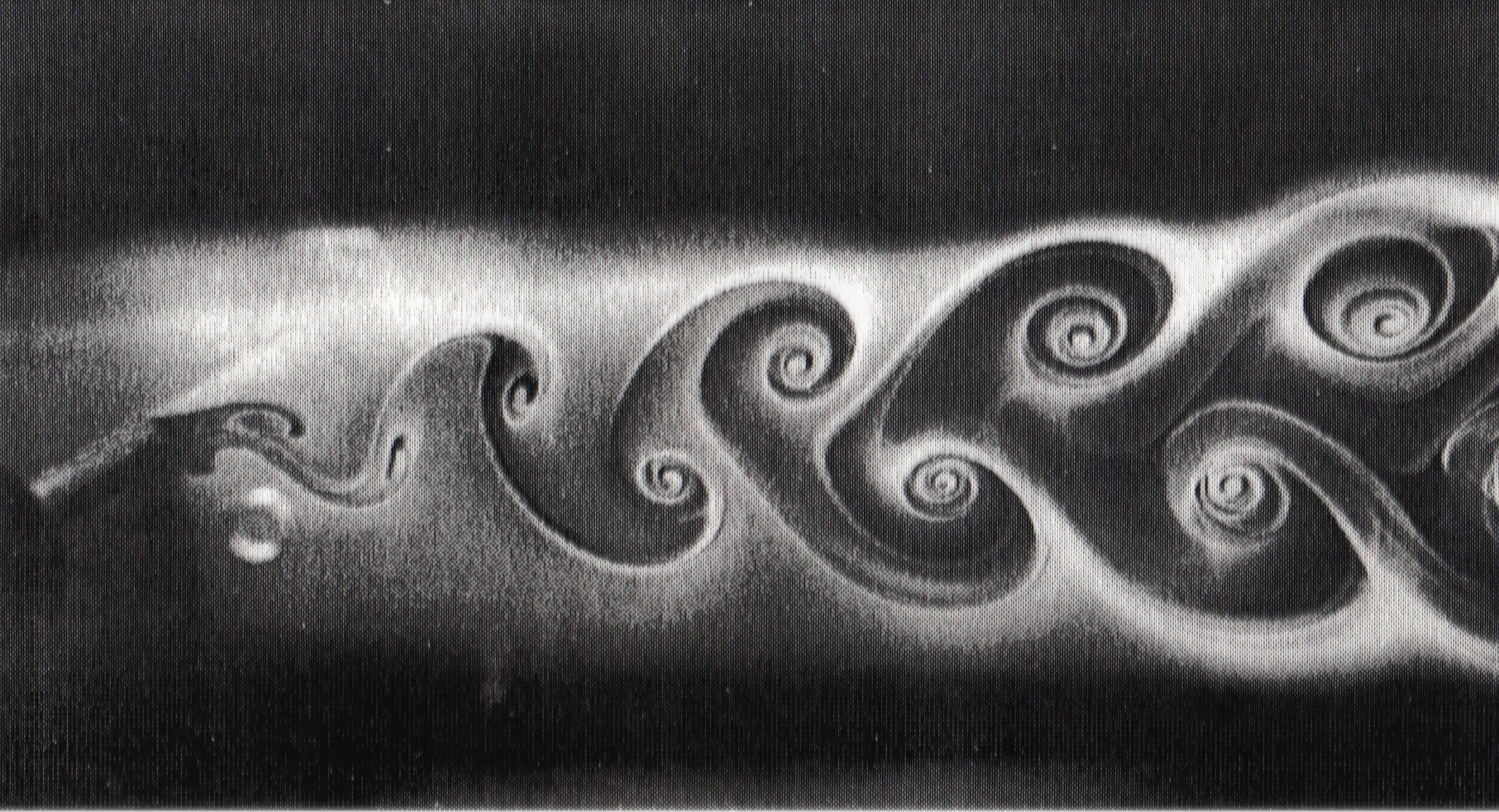
Image: Karman vortex street: asymmetric vortex shedding. Photo by Gary Koopman (Public domain, via Wikimedia Commons).
Imagine two leaves falling from the same tree.
At first, they seem to share the exact same future. They snap from the oak branch together, tilt into the same patch of crisp autumn air, and begin the same lazy, swaying descent toward the pavement. If you had to guess where they would land, you might confidently point to two spots on the concrete only a few centimetres apart.
Then, one leaf catches a microscopic curl of air, a tiny vortex spun off by a passing car hundreds of yards away.
The other flips. One leaf glides, one tumbles. One gets caught in an updraft, the other plummets into the shadow of a parked bicycle. A tiny physical difference becomes a visible difference, then an undeniable one. A few seconds later, they no longer feel like two versions of the same event. They feel like two entirely separate stories.
Nothing supernatural happened. The wind did not change its mind. The laws of physics did not take a coffee break. The leaves simply entered a world where small differences do not always stay small. They cascade.
That is the unsettling beauty of chaos.
Not chaos as in mess. Not chaos as in pure randomness, like static on a television screen. Chaos as in a perfectly lawful, mathematically rigorous system that can still violently outrun our ability to predict it.
“A very small cause which escapes our notice determines a considerable effect that we cannot fail to see... Prediction becomes impossible.”
Laplace’s Demon and the Clockwork Universe
To understand why chaos was such a profound shock to science, you have to understand the sheer arrogance of the 19th century.
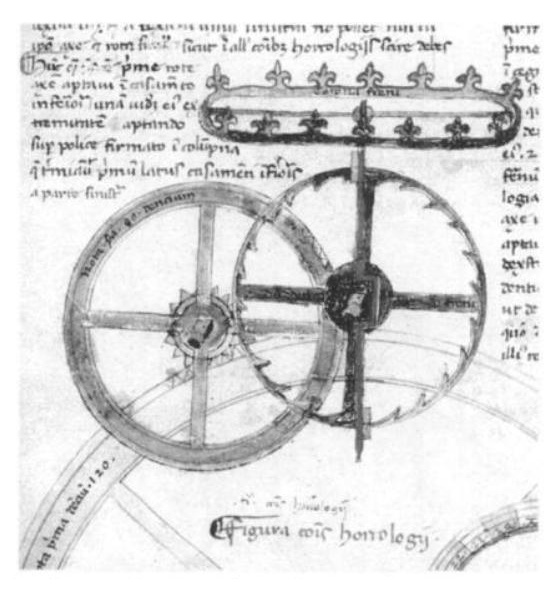
Following Isaac Newton’s discoveries, eighteenth-century natural philosophy increasingly pictured nature as a law-governed mechanical system, a deeply comforting image later sharpened into the metaphor of a clockwork universe.[9] Gravity, motion and momentum were all just gears turning other gears. When Edmond Halley used Newton’s laws to identify the comets seen in 1531, 1607 and 1682 as one periodic comet and predicted its return in 1758, it felt like a triumph of celestial prediction.[10] If we could predict the heavens, we could predict anything.
In 1814, a French mathematician named Pierre-Simon Laplace took this idea to its absolute, logical limit. He proposed a thought experiment that would haunt physics for a century.[2]
Imagine a super-intellect, Laplace wrote: a “Demon” that knows the exact location, mass, and momentum of every single atom in the universe at this exact millisecond, and understands all the forces acting upon them.
For this Demon, nothing would be uncertain. It could crunch the math and fast-forward the universe like a film strip. It would know the exact moment a star would collapse a billion years from now, and the exact spot a raindrop would hit your shoulder tomorrow. The future would be just as vividly visible as the past.
Physics spent over a century chasing Laplace’s Demon. The core assumption was simple and optimistic: if our forecasts fail, it is merely a failure of resolution. Our measurements just aren’t precise enough yet. Give us better sensors, faster computers, and more decimal places, and the future will eventually surrender.
Then, in the winter of 1961, a simulated weather system killed the Demon.
The Weather Machine That Refused To Repeat Itself
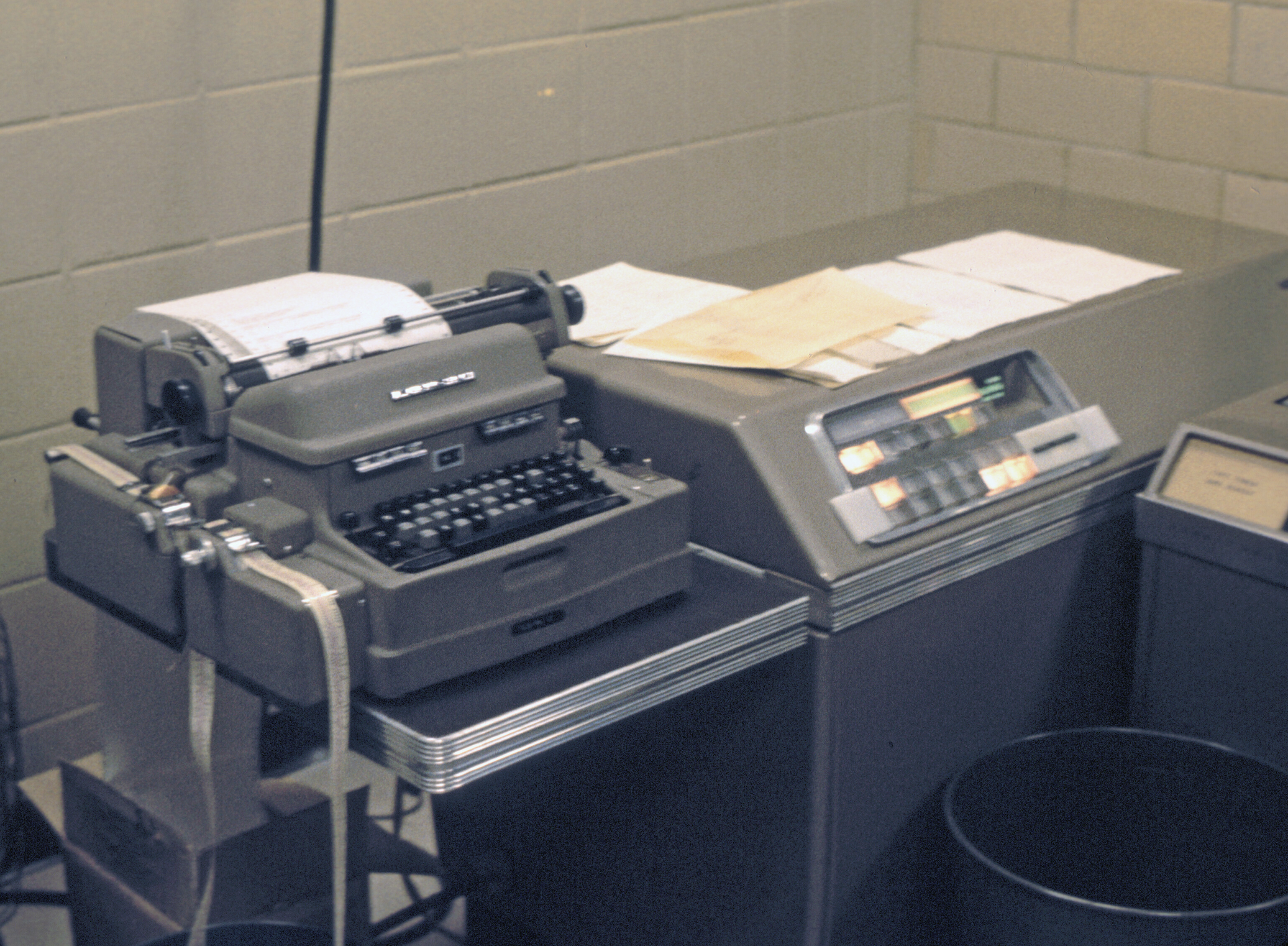
Edward Lorenz was a meteorologist at MIT running a stripped-down atmospheric model. Its twelve variables were computed on a Royal McBee LGP-30, a desk-sized machine with only 4,096 words of memory and paper-tape and typewriter input.[11]
One day, wanting to examine a specific weather pattern over a longer period, Lorenz decided to save time. Rather than starting the simulation from day one, he restarted it from the middle. He looked at a paper printout from an earlier run and manually typed the numbers back into the machine. Then, he went down the hall to get a cup of coffee.
When he returned, he expected to see the weather follow the exact same path it had taken before. Instead, he found an entirely new universe.
The new weather pattern had started out identical to the old one. But after a few simulated days, it drifted. Then, the two forecasts wildly diverged until they looked like completely different planets. One predicted calm skies; the other predicted a violent storm.
Lorenz was baffled until he realized what had happened.
The computer’s internal memory had been calculating the weather using six decimal places (for example, 0.506127). But the paper printout he had used to re-enter the data was rounded to three (0.506). Lorenz had assumed that a difference of one part in ten thousand, a mathematical fraction of a hair, was effectively zero. In a physical atmosphere, it was the equivalent of a puff of wind a thousand miles away.
To a human observer, the difference was microscopic. To a deterministic system, it was everything.
Lorenz had accidentally stumbled upon sensitive dependence on initial conditions.[3] He proved that determinism (strict rules) does not guarantee predictability. If a system is chaotic, the only way to predict its future perfectly is to measure its present with infinite precision. And the physical universe does not hand out infinite precision. A rounding error will grow teeth. A missing decimal place will become a hurricane.[11]
The Shape of a Bounded Mystery
What actually happens when a system goes chaotic? Does it just explode into white noise? Does it break all the rules?
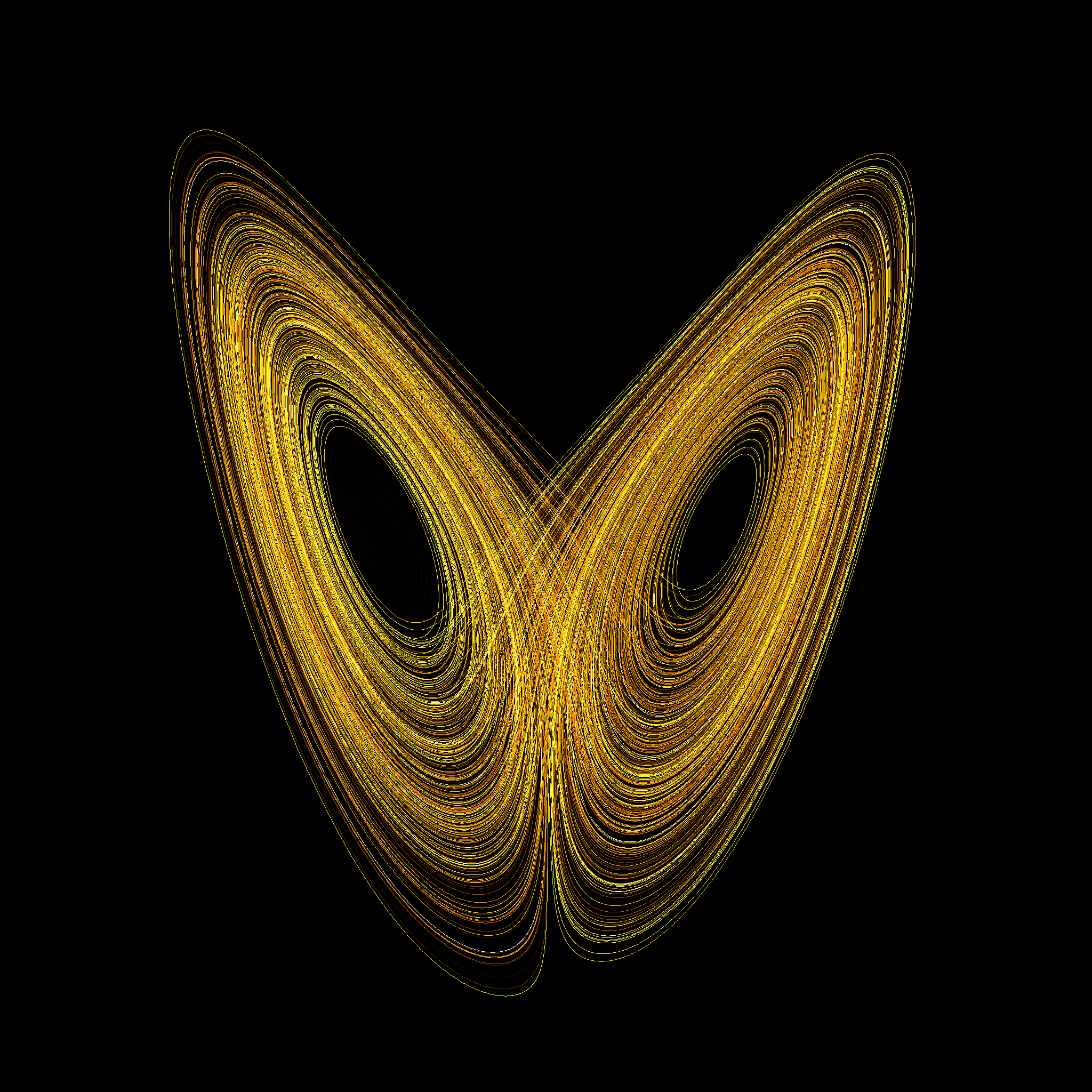
This is where Lorenz found something even stranger. He let his computer plot the chaotic weather data on a graph, creating a visual map of the system’s “states” (temperature, pressure, wind speed). The line looped and spun across the page, never crossing itself, never repeating the exact same path twice. If it crossed itself, the system would repeat and become perfectly predictable, and it was decidedly not.
Yet, the line didn’t just scribble off into infinity. The chaotic line was trapped.
It orbited two distinct, hollow zones, spinning a beautiful, infinite, three-dimensional web that looked remarkably like an owl’s mask. Or, quite fittingly, the wings of a butterfly.
This magnificent shape became known as the Lorenz Attractor.[3]
It proved that chaos has a geometry. The system will never do the same thing twice, but it is deeply confined to a specific shape of possibilities. The weather will never perfectly repeat, but it will also never spontaneously reach a billion degrees or drop below absolute zero. It is wild, but it is caged.
The Monster in the Algebra
You do not need an entire atmosphere to find this kind of chaos. You can find it hiding in a single line of middle-school algebra.
Look at the Logistic Map. It is an equation originally designed by biologists to track the boom-and-bust cycles of animal populations, and Robert May famously used it to show how simple deterministic rules can create complicated dynamics.[4] It looks entirely innocent:
This is just basic multiplication and subtraction. You take a starting population number between zero and one (), plug it into the formula with a growth rate (), and get the next year’s population (). Repeat the process.
If you set the growth rate low, say , the population safely settles into a perfectly stable, repeating number year after year. If you turn the dial up to , the population begins to bounce predictably between two numbers. Year one is high, year two is low. High, low, high, low. Perfect clockwork.
But if you turn the dial just a little further, to , the equation loses its mind.
The population numbers begin to violently jump around without ever repeating the same sequence twice. There are no dice being rolled. There is no hidden randomness. It is a strictly governed mathematical law, stripped of all physical reality, yet the outcome is entirely chaotic. Chaos doesn’t require a complex universe; it only requires a system that feeds its own output back into itself as a new input.
Try Breaking Prediction Yourself
This is where the math ends, and the visceral frustration begins.
Below is the Divergence Engine. It tracks 15 leaves under the same deterministic rules, but each reset gives them a newly generated wind field. There is no dice roll hidden in the descent: once the field and starting conditions are set, the motion is fixed. Laplace’s Demon would still know where every leaf would land, if it knew every detail of that particular run.
Lower the Release Spread toward the minimum, so the leaves begin almost on top of one another. Then turn down Air Turbulence and Leaf Flutter. Click Release, watch the cluster fall, and then choose Drop again. The rules stay the same, but the invisible wind has changed.
At first, the leaves may look like a single falling shape. Their ghost trails can resemble one thick cord cutting through the air. You may think you have made the future behave.
Then, watch what happens near the bottom of the screen. The next run begins with a different field, and a tiny difference in the air can send the leaves into a new family of paths.
The future starts charging interest. A microscopic divergence in the flutter, a fraction of a millimetre difference in the release position, and suddenly the thick cord unravels. The 15 leaves shatter into 15 entirely different, tangled trajectories.
Prediction fails not because the rules disappear, but because the rules strictly and relentlessly amplify the invisible.
Higher Stakes: Planets and Pulses
Once you see this sensitivity in the math, you realize it governs the very foundations of reality, from the scale of the cosmos to the rhythm of your own chest.
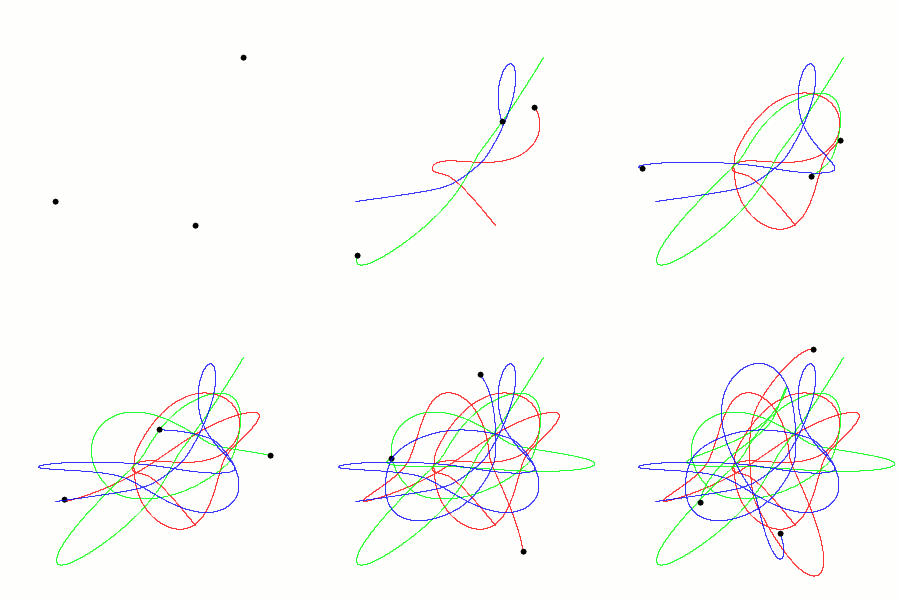
In the late 1800s, King Oscar II of Sweden and Norway sponsored a competition asking mathematicians to address a precise stability question in celestial mechanics. Henri Poincaré won the prize for his memoir on the (n)-body problem, although an error in the first printed version had to be corrected later.[12] The two-body problem has an exact closed-form solution. Add a third gravitational body, however, and there is no equivalent general solution: the interactions can produce extraordinarily complicated, chaotic motion.[12]
Because of this -body problem, gravity creates chaotic feedback loops. We cannot actually predict the exact positions of the planets in our solar system a few hundred million years from now.[5] Earth’s orbit is stable for our lifetimes, but on a long enough cosmic timeline, the solar system essentially forgets its own past.
Or take something far more intimate: the human heartbeat.
You might logically assume a perfectly metronomic, perfectly predictable heartbeat is a sign of ultimate health. In reality, cardiologists know that heart-rate variability reflects important autonomic regulation, and low variability can be associated with impaired adaptation.[6] A healthy human heart actually exhibits complex, fractal-like variations in its timing. It exists in a perpetual state of controlled flexibility, granting it the dynamic range to instantly adapt to sudden physical stress, a sudden fright, or a sprint for the bus. Absolute clockwork predictability in biology is a symptom of a system that has lost its ability to adapt.
The Future As A Shape, Not A Line
This is not an argument against prediction. Modern engineers predict structural loads, acoustics, fluid dynamics, and rocket trajectories with extraordinary, life-saving skill. But it means that every prediction, no matter how much data we feed it, has a hard horizon.
The best way to think about forecasting is not as a single steel track extending from now into forever, but as a cone.
Near the present, the cone is narrow. We can confidently say the bridge will hold its load today, the solar eclipse will happen on Tuesday, the leaf is falling downward. Farther out, the cone widens. Invisible errors multiply. A single definitive forecast splinters into a family of possible futures.
This is exactly how modern meteorologists think about uncertainty. They don’t run one simulation; they run an “ensemble,” meaning multiple forecasts with slightly different initial conditions or model versions.[7] Hurricane forecast cones communicate a related idea: the future track is not a line, but a widening region of uncertainty.[8]
That widening cone is not a failure of science. It is pure information. It tells us where precision ends, where probability begins, and where humility must take over.
Science is sometimes imagined as the gradual replacement of wonder with explanation. A phenomenon looks magical, we discover the mechanism, and the magic vanishes into a dry textbook. Chaos theory does the exact opposite.
It reveals that the universe is keeping secrets from us, not because it is mystical, supernatural, or random, but because it is too intricate, too folded, and too fiercely hyper-realistic for our crude human tools to perfectly capture. Laplace’s Demon is dead, but what replaced it is far more beautiful.
Somewhere inside that ordinary transformation, whether a rounding error, a third gravitational pull or a falling leaf, is one of the strangest truths in physics:
The universe does not have to be random to surprise us.
References
Henri Poincaré, Science and Method, “Chance,” 1908. Maitland trans., 1914, p. 68; Halsted trans., 1913, p. 397.
Pierre-Simon Laplace, A Philosophical Essay on Probabilities, English translation hosted by Project Gutenberg.
Edward N. Lorenz, “Deterministic Nonperiodic Flow”, Journal of the Atmospheric Sciences, 1963.
Robert M. May, “Simple mathematical models with very complicated dynamics”, Nature, 1976. A readable archived copy is also hosted by Caltech/IPAC.
Martin J. Duncan and Thomas Quinn, “The Long-Term Dynamical Evolution of the Solar System”, Annual Review of Astronomy and Astrophysics, 1993.
Adina E. Draghici and J. Andrew Taylor, “The physiological basis and measurement of heart rate variability in humans”, Journal of Physiological Anthropology, 2016.
NOAA National Weather Service, Glossary: Ensembles, and NOAA Climate.gov, “What is predictability?”.
NOAA National Hurricane Center, “Definition of the NHC Track Forecast Cone”.
Newton’s Principia and the clockwork-universe interpretation, Stanford Encyclopedia of Philosophy, Fall 2015 edition.
NASA, “955 Years Ago: Halley’s Comet and the Battle of Hastings”, documenting Halley’s 1758 prediction and the comet’s delayed 1759 perihelion.
D. J. Raymond, “The Saltzman–Lorenz Exchange in 1961: Bridge to Chaos Theory”, Bulletin of the American Meteorological Society, 2024.
Institut Mittag-Leffler, “From Order to Chaos: The Prize Competition in Honour of King Oscar II”, including the competition history and Poincaré’s revised memoir.
Further Reading
If you want to venture further into the strange geometry of the unpredictable, these works form the definitive reading list on Chaos Theory:
- James Gleick, “Chaos: Making a New Science” (1987). The absolute gold standard of popular science writing on this topic. It reads like a thriller and introduces all the major players, from Lorenz to Mandelbrot.
- Edward N. Lorenz, “Deterministic Nonperiodic Flow”, Journal of the Atmospheric Sciences, 1963. The original paper that killed Laplace’s Demon. Dense, but historically monumental.
- Steven Strogatz, “Nonlinear Dynamics and Chaos” (2014). For those who want to see the actual math, this is the most accessible and beloved textbook on the subject, full of intuition and brilliant diagrams.
- NOAA Climate.gov, “What is predictability?”. A practical look at how meteorologists work within the cone of uncertainty today.